
AI Plans Routes That Senior Dispatchers Would Build, in Seconds
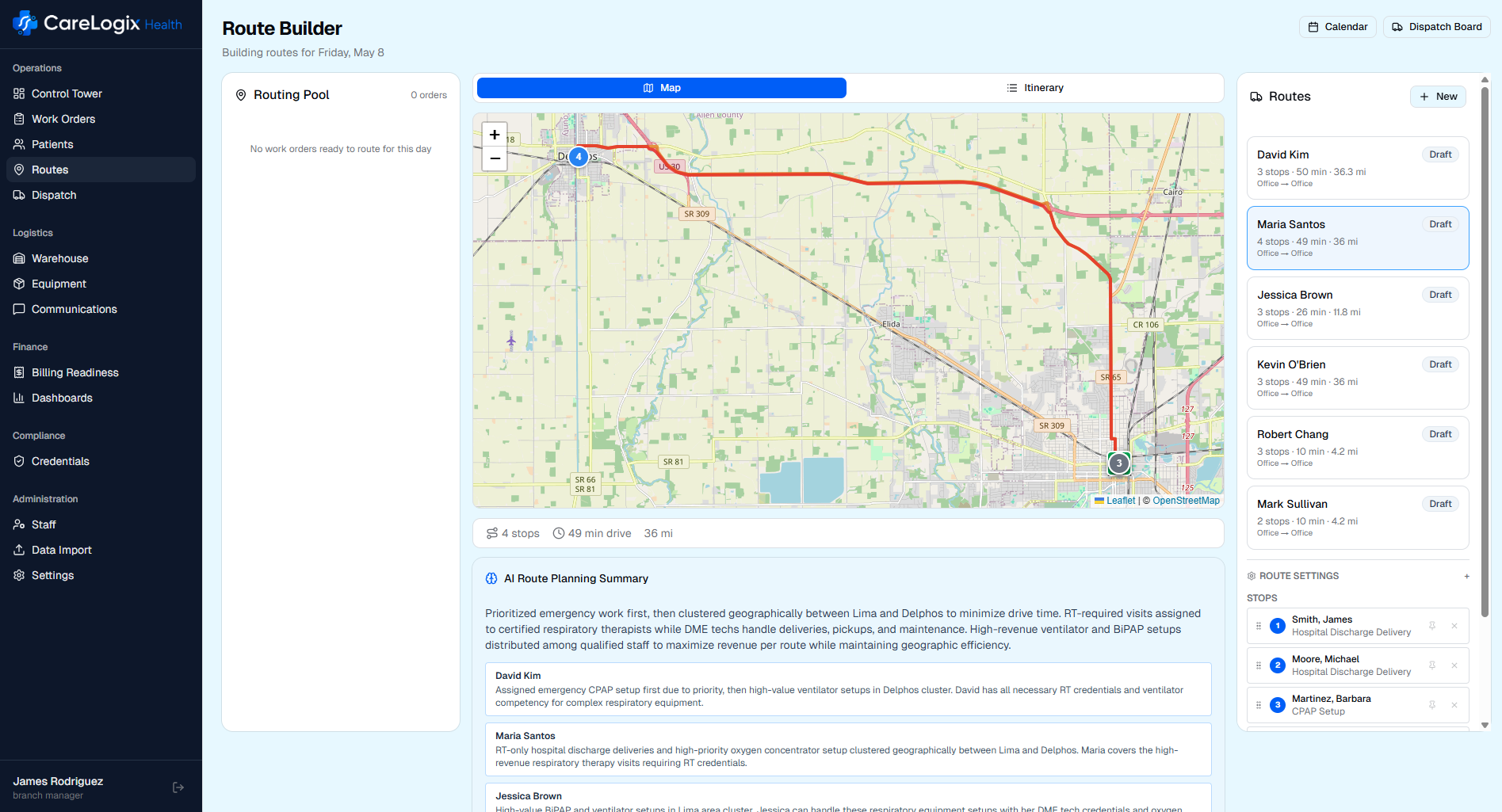
Your best dispatcher holds the entire territory in their head: which techs are credentialed for what, which neighborhoods cluster well, which patients need morning slots. CareLogix AI captures that logic and applies it to every route, every day, using real road data. One click replaces hours of manual route building.
Manual Routing Burns Capacity You Cannot Afford to Lose
In most DME operations, route planning is a daily ritual that depends entirely on dispatcher experience and memory. A senior dispatcher opens the work order queue, scans through dozens of stops, and begins mentally sorting them: this cluster goes to the north side, that oxygen refill needs a respiratory tech, this delivery has a narrow time window.
The result is a route that works, but is rarely optimal. Techs drive 30-40% more miles than necessary. Stops that could be grouped get spread across multiple routes. A tech credentialed for complex setups gets assigned simple deliveries while another tech struggles with work above their skill level. Overtime creeps in because the route was front-loaded in the morning and back-loaded in the afternoon.
When that senior dispatcher is out sick or on vacation, the operation falls apart. Junior dispatchers lack the territorial knowledge and produce routes that cost you fuel, overtime, missed appointments, and frustrated patients. The knowledge lives in one person's head, and it walks out the door every evening.
How It Works
- 1
AI Analyzes Unrouted Work Orders
CareLogix pulls every ready, unrouted work order and evaluates location, visit type, equipment requirements, patient preferences, and time constraints.
- 2
Groups by Geographic Proximity
Stops are clustered into geographic zones using real coordinates, not zip codes, to minimize drive time between consecutive stops.
- 3
Matches Staff Credentials
Each cluster is assigned to a technician whose credentials, certifications, and equipment authorizations match the visit requirements. Complex setups go to qualified techs.
- 4
Optimizes With Real Road Data
Routes are sequenced using OSRM road network data with actual drive times on actual roads, not straight-line estimates. Turn restrictions, one-way streets, and highway access are all factored in.
- 5
Review and Lock
Dispatchers review AI-built routes on the map, make adjustments if needed, and lock routes for the service day. Techs receive their itineraries with turn-by-turn directions.
Key Capabilities
ROI Impact
35% more patients per route, 30-40% less windshield time
Connected Workflow
This module works hand-in-hand with the rest of CareLogix.
Real-Time Dispatch
Planned routes flow into the dispatch board with road-level visualization, arrival windows, and real-time tracking.
Learn moreWork Order Management
Only ready work orders enter the routing pool. Blocked orders stay visible but do not consume route capacity.
Learn moreBilling Readiness
Completed routes feed the billing readiness engine, which evaluates every visit for billing completeness the same day.
Learn moreStop Building Routes From Memory. Start Optimizing With AI.
See how CareLogix transforms your operation in a 30-minute walkthrough.